Showing posts with label jiu-jitsu. Show all posts

Friday, January 31, 2014

3 Organizations Using Jiu-Jitsu as a Force for Good


I love training Brazilian Jiu-Jitsu because of the technical depth of the sport. It's mentally and physically challenging while also serving as a creative outlet. No session on the mat is ever the same, and improving in the art is incredibly rewarding.

But that's only part of what has kept me on the mat for upwards of 8 years now.

Beyond the technical and physical aspects of the sport is the jiu-jitsu community as a whole. The friends I've made and the places I've been because of jiu-jitsu have transformed a hobby into a lifestyle. I've been blessed in this regard, and I am thankful for the doors that jiu-jitsu has opened for me. Jiu-jitsu has helped me develop as a person; it's helped my career; and it's guided me through more than a few life challenges. And others see jiu-jitsu as a force for good, so much so that they are using it as a vehicle for not only improving themselves but also for enhancing the lives of others.

Here are three organizations that are pushing the envelope of what jiu-jitsu can do for our communities.

1. Tap Cancer Out

Jon Thomas took the energy and passion of a jiu-jitsu tournament and channeled it into raising money for cancer research. His nonprofit runs grappling tournaments specifically geared toward fundraising, which has spawned satellite fundraising efforts from merchandise sales and donations. What's most impressive, to me, about Jon's work is not the big fat $60,000 check that he presented to the Leukemia and Lymphoma Society recently but the way he has mobilized the jiu-jitsu community to do good with an art that is already having a profound impact on many lives. If there is a Tap Cancer Out tournament near you, make it a point to attend.

2. Groundswell Grappling Concepts

Under the leadership of Emily Kwok, Valerie Worthington, Hannette Staack, and Lola Newsom, Groundswell has filled a void in the BJJ community by running all-women grappling camps. These camps quickly blossomed into a community within the jiu-jitsu community and spawned an important conversation about the future of jiu-jitsu culture. Because of Groundswell, more jiu-jiteiros are talking about how to make the mat a more inclusive, welcoming place. Members of my home school rave about Groundswell camps, and I've been fortunate enough to train with Valerie at one of her seminars. The work that Groundswell is doing is important, and it's really just begin.

3. The 100

The 100 is the brainchild of Tom Callos--the guy who introduced BJ Penn to jiu-jitsu and the father to Keenan Cornelius. Not strictly a jiu-jitsu endeavor (it encompasses all martial arts), the 100 provides business advice to martial arts school owners so that they can run more successful schools, but the 100 definition of success is not the traditional definition of success. Where some high profile martial arts business gurus (you know who I mean) talk only about maximizing profit, the 100 takes a more holistic approach to what it means to be successful. The 100 looks at everything from designing more friendly student contracts to incorporating life skills like anger management into what we teach on the mat. The 100 even mobilizes martial arts leaders for projects akin to Habitat for Humanity, building houses or renovating dojos. Even if you aren't a school owner, following the 100 will help to expand your perspective.

Do you know of a person or organization using jiu-jitsu as a force for good? I'd love to hear about them!

Thursday, March 7, 2013

Your Humble Muscles Need More Reps


On Sunday morning, I dropped into my school's open mat to rehab a back injury and to teach an informal private lesson. After 20 minutes of solo movements, slowly and carefully increasing my mobility in an effort to baby and accelerate the healing of my strained lower back, one of my black belt instructors asked if I'd like to roll.

I was having trouble bridging without pain and any sort of twisting triggered an intense tightening of my core muscles. I had been dealing with the injury for a little more than a week and was doing my best to keep my training light enough so that the minor pain did not morph into a serious problem.

So I said yes and rolled intensely for an hour.

Thought my decision was not a wise one, I learned a lot from that roll, as I always do when training with grapplers that outrank me. I've been learning from this particular instructor for seven years now, and every roll is an opportunity to gauge my progress, to experiment, and to identify areas for improvement. I never win, but I am able to survive a little bit longer here or react a little bit more quickly there, and since I know I am losing to pure technique, I can map out what technical aspects of my game I should dedicate the next month to.

But the biggest lesson I learned from this black belt that morning did not come from the roll.

After we finished training, he asked me about my experience with the berimbolo. I admitted that I had played with it a little but found that I wasn't really cut out for it, in large part because of my physical limitations and partially because of my overall style of rolling.

"Why do you ask?"

"Well," he began, "I don't see it fitting much into my game either, but I'd like to learn more about it so that I can defend it and so that I can teach it. I've been playing with a few ideas, but I haven't used it enough to really say that I know all of the ins and outs."

Later, when I was partway through my private, I saw him talking to a blue belt about the berimbolo, discussing approaches, strategy, and tactics and even getting feedback on his technique. The black belt, a seasoned competitor and legitimately ranked instructor, recognized a hole in his knowledge and was humble enough to learn from a blue belt. Even though the black belt far surpassed the blue belt on overall technical ability, the blue belt had something new to share, and it takes a certain perspective to realize that that's okay.

It's very easy to forget that we are all white belts at something. There is no shame in not being an expert in everything, and we can sometimes forget that our gym as a community. Community means that everyone has the potential to contribute productively.

Tuesday, February 19, 2013

Women in Brazilian Jiu-Jitsu: A Guide for Dudes

My fiancee and two my favorite female jiu-jiteiros striking a fighter pose
with a knight at the Pittsburgh Renaissance Festival.
I apologize for my absence. I've been working on some big projects, which you can hear more about by listening to my interview with Inside BJJ.

For much of my career, I have given little thought to women in jiu-jitsu. I trained with female jiu-jiteiros at home and abroad, and I read interviews with talented female competitors and watched instructionals featuring gifted female instructors, but I never paid much attention to the challenges that they faced. My thought process stopped at, "Oh, it must be kind of awkward to be a female in a male dominated sport like jiu-jitsu--Oh, sweet. A new armbar video."

Recent months have changed my perspective dramatically, and now something seems very clear to me: Jiu-jiteiros everywhere, we have a problem, and that problem is how we treat the women in our sport.

Friday, December 14, 2012

Social Media for Jiu-Jitsu Gyms (3 Parts)


This article was originally published by BJJ Weekly in three parts. The impetus for writing it came from both my jiu-jitsu travels and my work as a fight writer. I've had the pleasure of networking with a great many students and instructors, which has exposed me to their marketing efforts and their social media efforts. I see a lot of talented instructors with awesome students struggling to attract new students to their gym. That makes me sad. I believe that jiu-jitsu can be for everybody, and the fact that there are people out there that may never get the chance to try it because nobody told them about it is tragic.

I owe my humble success to online communities. Were it not for the support of Charles Pearson at Lockflow.com and the support of the Lockflow community, my writing career may have never gotten off the ground. I will also take a little bit of credit for Lockflow's expansion on to social media, which included weekly podcasts and fight of the week videos when I was working there full time.

Thursday, December 6, 2012

Sport vs. Self-Defense: Refresh Your Perspective


Having trained and taught for some time, I have had the pleasure and displeasure of having to share and defend jiu-jitsu with all sorts of different people. I can't tell you how many times I've heard that sport jiu-jitsu is a waste of time because we would never use x-guard or inverted guard or any other unusual position that you can think of in a street fight.

These naysayers are right about one thing: no, we probably wouldn't use x-guard in a street fight, and I probably wouldn't use butterfly guard either, but they are wrong about the why.

I wouldn't use x-guard in a street fight because I wouldn't have to. In a street fight, where it's my six years of grappling experience against some dude with Jack Daniels courage, simple positions like mount, back control, or closed guard will do the trick just fine. In this scenario, a simple problem warrants a simple solution. Anything more than that is a waste of effort on my part.

Thursday, November 29, 2012

Part 3 of Using Social Media to Grow Your Gym


Read the entirety of part 3 by clicking here.


For the last two weeks, we have been talking about how to use social media to strengthen your community and create a lifestyle that persists outside of your gym. To make this guide more concrete, we have been referencing the social media campaign of Junior Achievement, using their challenges and their successes with online communities as a framework for jiu-jitsu communities.

Once you have created advocates and built an online community that reflects your offline community, the next step is to empower your advocates to spread the word about your gym for you.

When I reached this point with Junior Achievement’s fundraiser, we had built up so much momentum that advocates gladly promoted the fundraiser and related events to their friends and followers. Multiple journalists and bloggers wrote about the fundraiser and tweeted about it. Our Facebook and Twitter followers shared and retweeted our updates. And local celebrities plugged Junior Achievement through their websites and social media. On this front, Pittsburgh Dad was the highlight. If you don’t know Pittsburgh Dad, you’re probably not from Pittsburgh. Pittsburgh Dad YouTube videos have become a part of the local culture, and his following is enormous. When he posted about the fundraiser, our revenue skyrocketed almost instantly.

Wednesday, November 21, 2012

Part 2 of my BJJ Weekly on Using Social Media to Grow Your Gym


Read the full article at BJJ Weekly.


Last week, we talked about the basic goals of social media and of community building, using my work with a non-profit as an example case study. As you begin to develop your strategy, creating and empowering advocates should be the core of your social media activities, and that core is strengthened through a variety of tactics. Having an active Facebook page may help you turn gym members into passionate advocates, but the real process starts offline, within the walls of the gym.

On this front, Junior Achievement was well ahead of most organizations turning to social media to boost the impact of their marketing efforts. Junior Achievement has been working in the community for decades, and their alumni are sprinkled across the world. They are reasonably well-known and respected, and they host numerous events for a wide range of community members. Offline, Junior Achievement’s community is thriving. It is vibrant and healthy, and everyone involved is happy and passionate about the organization. Their social media was weak because they had not made the effort to make their online presence match their rich physical presence
.

Tuesday, November 13, 2012

Is Your Gym Using Social Media to Effectively Attract and Retain Students?


Check out my latest article series in BJJWeekly:


Junior Achievement is an international non-profit that teaches children about business and financial literacy. They foster entrepreneurism and teach money management. Their programs have been proven to increase scholastic performance and reduce dropout rates, and they do a lot of good for the communities connected to their respective chapters, but with federal funding becoming increasingly sparse, Junior Achievement is relying more and more on fundraising to keep their doors open and their programs alive.

I recently helped the Western Pennsylvania chapter of Junior Achievement use social media to generate awareness for one of its largest annual fundraisers: a raffle for a package of season tickets for a variety of Pittsburgh sports teams. We boosted revenue by 9% over the previous year, and from the point that we launched the social media portion of the campaign to the time that the fundraiser ended, we raised $60,000.


Thursday, November 8, 2012

Open Mat: You're Doing It Wrong


The first rule of Fight Club is that you don't talk about Fight Club.

The first rule of open mat is that open mat is not Fight Club. Open mat is not a free for all throw down session where you spend three hours giving and taking as many beatings as you can. Some people make open mat about sparring and sparring only, but that's a mistake. Open mat is a unique opportunity for you to focus on your own personal development as a grappler. It's a chunk of mat time where you can choose what you work on and how you work on it.

  • When you take a class, you are potentially exposed to new techniques and new connections that you may have difficulty discovering on your own, which helps to develop you and the school as a whole.
  • When you roll, you have a chance to apply in real time the techniques that you have been practicing.
  • When you go to open mat, you can use your rolling experiences to identify your weaknesses and begin working to patch the holes in your game.

Wednesday, September 26, 2012

Jeff Rockwell On Training for Longevity


This past weekend, I was fortunate enough to attend a Jeff Rockwell seminar in State College, Pennsylvania at Momentum Fitness. If you have not heard of Rockwell, do not be surprised. He is one of the best kept secrets in jiu-jitsu. He may not be headlining pay per views, but he is an incredible technician and an even better instructor. Once Austin, Texas (where Rockwell is now located) figures out that they have Rockwell in town, the Texas Brazilian Jiu-Jitsu scene is going to change dramatically. [If you know of instructors like Rockwell, talented but well-kept secrets, please email me]

Rockwell spent the majority of the seminar covering his version of the sit-up escape and the system that he built around it, and he touched briefly on his take on the crucifix, which our mutual friend Matt Kirtley is a big fan of. While I wish I was good enough to show you the techniques that Rockwell taught, because they were pretty awesome, I would not be able to do them justice, so you are going to have to contact him or drop in on one of his classes to learn them the right way: directly from Rockwell. What I would like to share is what struck me more than his techniques, and that was a piece of his jiu-jitsu philosophy.

Thursday, September 13, 2012

Jiu-Jitsu is Not the Gentle Art


One of my readers recently sent me a question, and it touched on a conversation that I have had many times with my students, so I thought it would be helpful to share my answer with everyone.

“One thing that I really have a problem with is 'pulling the trigger.' I got a guy in a submission, had it, but I could not ‘go.’ I felt bad about hurting him. I apologize so damn much when I train, knee on belly: 'you ok?' armbar: 'you ok?'  So, not only am I really in my head all the time, I am worried about people all the time. So, when I roll I think, think, think, and get flipped, spun and tossed.” -Mike

This is a surprisingly common problem in jiu-jitsu, and it’s not a terrible problem to have.  If you, and I mean both Mike and my readers, feel bad about hurting your training partners, that’s a good sign.  You are starting at the right end of the spectrum, which is a much better place to be than the opposite, where a student has no concern for the safety or the health of his teammates.  It is much easier to work with someone that cares than who does not care.

Thursday, September 6, 2012

Belts, Awards, and Two Inches of Your Ass


Royce Gracie is credited with the statement "A black belt only covers two inches of your ass; you have to cover the rest."

Jiu-jiteiros everywhere take this to mean that a belt does not make the grappler.  The grappler makes the grappler.  No matter what color is around your waist, fighting and winning are on you.  Your skill, your character, and your resolve are what define you on the mat.  The belt is just a piece of fabric.

Is it though?

Tuesday, August 28, 2012

There is No "I" in Team, But There Are Two in Jiu-Jitsu


We often talk about our team and the unity of your gym.  Being a positive presence in the gym, being a good training partner, and representing your gym in a positive light off the mats are all an important part of the jiu-jitsu lifestyle.  In our emphasis on teamwork, we understate a part of training that is sometimes more important than supporting the group.

Jiu-jitsu is a personal journey, and your primary focus should be on you.

This likely sounds strange in a culture that promotes humbleness and has mottoes like "leave your ego at the door," but it's important.  Selfishness is negative when you put yourself above others.  Selfishness is positive when you can use it to increase your enjoyment of a hobby without hindering anyone else's enjoyment.  You chose to train jiu-jitsu.  You pay your mat fees.  You bought your equipment.  You provide your health insurance.  And you make the decision to risk injury by participating in a combat sport.  You stepped on the mat for you.  Do not forget that.

Wednesday, August 22, 2012

Everyone is Still a White Belt at Something


Everyone starts as a white belt.  I certainly did, as the faux tough guy picture above clearly shows (I am on the left).

More importantly though, every technique starts at white belt.

Your overall rank may be purple, but that does not mean that all of your techniques and positions have reached the purple belt level.  In fact, you are probably still a white belt in some areas, and you may have reached brown belt in other areas.  Your favorite spider guard sweep, the one you constantly hit in the gym and in competition, may be at the brown belt level while that new set up for the omoplata that you saw in class yesterday is at the white belt level.

Tuesday, May 1, 2012

3 Lessons Learned After a Weekend with Matt Kirtley (Aesopian.com)


Matt Kirtley of Aesopian.com fame visited Pittsburgh to give a seminar for the Martial Arts Club at California University of Pennsylvania (Cal U), a club that I founded as an undergraduate and now instruct.  For my students at Cal U, a seminar from Matt was an opportunity to experience black belt level jiu-jitsu and a chance to see a different perspective on grappling.  For me, Matt's visit was a chance to spend time with a friend and to repay him for the years of free jiu-jitsu that he had shared through his blog.  He accepted payment in the form of sushi and burgers, which is a form of currency that resonates with me as well.

First of all, Matt's instruction is as good as you would expect after reading his blog or watching his videos.  His seminar at Cal U focused on the crucifix and the reverse omoplata, and he was able to breakdown what some would call advanced techniques, making them as accessible as armbars to students that were relatively new to grappling.  Since his seminar, I have been receiving texts and emails about people hitting their first live reverse omo or finishing one of his choke variations.  Matt's ability to clearly explain highly technical movements and details is impressive, and I absorbed a great deal of technical knowledge from him, but the most important lessons I learned from Matt were more abstract and more important than any individual technique.

Tuesday, April 10, 2012

Visualizing the Pulse of BJJ Blogs

The internet has become an important part of jiu-jitsu culture, and in many ways, it has been responsible for the continued growth of the sport.  We turn to blogs and videos and podcasts for technical analysis and updates on jiu-jitsu culture.  The internet keeps us entrenched, and it keeps us connected.  Just as grapplers develop their own styles bloggers too tend to focus on certain areas of jiu-jitsu.  I'm a nerd, and I enjoy exploring these trends in new ways with the hope of gleaning new meaning from my usual reading.  Below, I have made some word clouds of my favorite jiu-jitsu blogs.  The words that appear are what they talk about most, and the bigger words are the ones that appear most often.

Thursday, April 5, 2012

I was in the background of a Tosh.0 video


The above video is from the popular Comedy Central show Tosh.0.  It features two young grapplers at the PA State Grappling Championships, held annually at Keystone Oaks high school in Pittsburgh.  The video is standard Daniel Tosh irreverence, but yours truly (me) happened to be refereeing this particular match.  I am nothing more than a background figure in the video--even family members said to me, "I wasn't sure if that was you"--but this video reminds me of two very important facts:

1. Jiu-Jitsu can be a safe sport if trained properly. Education, respect, and maturity are important qualities to foster on the mat.  Kids will be kids, but as adults and coaches we need to make sure that children understand the potential dangers and the competition rules.

Friday, March 23, 2012

[Video] The Hip Sweep: Working in Clusters vs. Sequences


The hip sweep is a fundamental technique.  My game tends to favor technique like the hip sweep.  Minimal flash, high percentage, no prerequisite physical attributes, and integrates easily with other fundamental techniques.  In this particular instructional, I want to focus on the connections between techniques and how we think about those connections.  Capitalizing on these connections is how you get what r/BJJ would call "Mad Flow" (it's Mad Flow month over there), and mad flow makes you aggressive and efficient.

You can flow in two ways: in a cluster or in a sequence.  I owe Matt from Aesopian.com for this particular insight (and for the sketch above).  Before talking to Matt about mad flow, I knew that some techniques had a two way connection and that these two way connections, when considered as a bigger picture, form a network of techniques that overlap.  When Matt brought up the idea of thinking of techniques as clusters or as sequences, he made clear a very important distinction.  Some connections do not have a two connection.  The relationship is linear, which is key when developing a game plan.  Below is a map of the hip sweep cluster contained in the video, and below that is an example of a sequential combination.

Tuesday, March 13, 2012

Be Like Marcelo Garcia (Or Don't)


Marcelo Garcia is a phenomenal grappler.  And so is BJ Penn.  And Dave Camarillo.  And Demian Maia.  And John Danaher.  And Renzo Gracie (and pretty much every Gracie for the matter).  We look up these grapplers, and we seek to emulate their often god-like abilities, but there is one thing that all of these individuals have in common that the vast majority of us normal guys and girls don't: they have a lot of time to train.

Thursday, March 8, 2012

Ego, the Tapping Point, and the Breaking Point


Ego is the enemy of jiu-jitsu, a friend once told me.  Check your ego at the door; there's no place for it on the mat is another oft-repeated nugget of wisdom.  Instructors, both famous and obscure, advocate abandoning the ego.  It clouds your judgment.  It distracts you in training.  It can prevent you from learning.  As jiu-jiteiros, we have heard this advice many times, yet ego continues to haunt us and our sport.

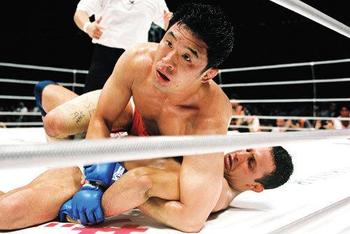
In the above picture, Renzo Gracie is watching his arm break.  This is a famous picture (you can click here if you are interested in watching the video), and Renzo has said in multiple interviews that he did not want to give Kazushi Sakuraba the pleasure of knowing that he made Renzo quit.  Even in the locker room after the fight, Renzo acted as though he was not maimed and not in pain because he did not want to give Sakuraba the satisfaction of seeing him suffer.