Showing posts with label health. Show all posts

Thursday, March 8, 2012

Ego, the Tapping Point, and the Breaking Point


Ego is the enemy of jiu-jitsu, a friend once told me.  Check your ego at the door; there's no place for it on the mat is another oft-repeated nugget of wisdom.  Instructors, both famous and obscure, advocate abandoning the ego.  It clouds your judgment.  It distracts you in training.  It can prevent you from learning.  As jiu-jiteiros, we have heard this advice many times, yet ego continues to haunt us and our sport.

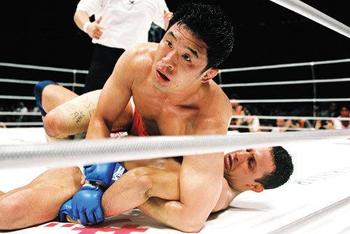
In the above picture, Renzo Gracie is watching his arm break.  This is a famous picture (you can click here if you are interested in watching the video), and Renzo has said in multiple interviews that he did not want to give Kazushi Sakuraba the pleasure of knowing that he made Renzo quit.  Even in the locker room after the fight, Renzo acted as though he was not maimed and not in pain because he did not want to give Sakuraba the satisfaction of seeing him suffer. 

Tuesday, March 6, 2012

Compete with Caution and with Awareness


Warning: the above video is extremely graphic in nature.  Watch at your own risk.

In the above video, an amateur fighter dislocates his knee or breaks his leg (the exact injury is not immediately apparent, but the injury is gruesome) while defending a takedown.  The injury is visibly serious, and I would be surprised if the injured fighter is ever able to compete again.

Brazilian Jiu-Jitsu and mixed martial arts are growing sports.  More people are watching, and more people are competing.  As a student and as an instructor, I often see fighters that are eager to compete, both on the mat and in the cage.  Excitement and eagerness are good qualities in this sport, but overeagerness can be dangerous.  Jumping into competition without the proper training is an unnecessary risk, yet I often see fighters with too little experience strapping on 6 oz. gloves and cranking up their walk-out music.  Everybody wants to be an Ultimate Fighter or a grappling all-star, and far too few voices are encouraging moderation.

Tuesday, February 28, 2012

NeoCell Follow-Up Interview


In my pursuit for better joint health, I am willing to try almost anything.  A few weeks ago, I wrote about the conclusive study on glucosamine chondroitin that found no link between taking the supplement and better joint health, and I also wrote about the debated benefits of taking collagen to improve joint health.  A conclusive study on collagen has yet to be conducted, and the current research offers mixed opinions as to whether or not collagen can improve the integrity of joints.  At the same time, however, I was a bit hard on NeoCell, the supplement manufacturer that sparked my interest in collagen in the first place, and I feel that it's only fair that they get to defend the merits of their product, especially since the research has yet to offer a definitive answer.

The following is a brief interview with Sarah Quadri, NeoCell's resident biochemist.  The italicized sentences are mine.

Tuesday, February 14, 2012

Not In the Face (Thanks)


Last week, I talked about recent research that revealed that exercise can preserve muscle integrity well into your later years, but only the muscles that you exercise regularly will benefit.  This is great news if you're a grappler because jiu-jitsu is a full body activity, and this is not so great news if you're a runner.  On that same vein, there is another reason to choose jiu-jitsu over another martial art (or even mixed martial arts): pugilistica dementia.  Pugilistica dementia is a condition often associated with boxers where traumatic brain injury is frequent and common, resulting in a slew of cognitive impairments.  Matt Pitt, a physician and Sherdog contributor, recently wrote a great article on pugilistica dementia, and he revealed a characteristic of pugilistica dementia that should concern all of us:
...although the disease was long thought to be an acceleration of normal aging, perhaps a form of Alzheimer's disease brought on by trauma, the evidence proves otherwise. Alzheimer's disease produces scarring diffusely throughout the brain, but autopsy studies of ex-boxer's brains show a very different pattern of injury. In boxers' brains the scarring is predominantly along the surfaces of the brain, most commonly along the frontal and temporal lobes where punches have led to repeated contact between the bony prominences of the inner skull and the delicate surface of the brain.

Friday, February 10, 2012

Jiu-Jitsu: A Lifetime of Fitness


As obesity rates rise and serious health conditions are linked to inactivity, finding a way to stay fit and active is becoming more and more important.  Some people take up running.  Others take up lifting weights.  Unfortunately, not all exercise is created equal, especially if your goal is to stay healthy late into your life.

According to a recent study conducted by researchers at the University of Western Ontario, exercise will only preserve the specific muscles that you are exercising.  By comparing the quality of various muscle groups in runners young and old, they found that in the older runners the muscles typically associated with running were still in good health and functional, but the muscles that were not activated by running, like biceps, were not preserved.  While this sounds like common sense, it reveals that taking up a hobby like running will not by itself improve or maintain your overall health.  As Sweat Science puts it:

Thursday, February 9, 2012

Choose Your Jiu-Jitsu Family Wisely


I was browsing my blogroll when I stumbled upon an article by Dan Fagella at Science of Skill, a jiu-jitsu blog that aims to examine jiu-jitsu through a scientific lens.  In November, Dan interviewed Dr. Jeff Nishii, who holds both a PhD in psychology and a black belt in Brazilian Jiu-Jitsu.  Dr. Nishii recently launched a blog on jiu-jitsu psychology, and Dan's interview provides a general overview of how psychology can help us to better understand jiu-jitsu.  The entire article is pretty interesting, but the paragraph on psychodynamic theory as it relates to gym culture caught my eye:
In psychodynamic theory there is a lot of emphasis places on the family and relationships therein. The BJJ academy, in a sense, can potentially become a family-like experience, with the different regular interactions, rules of the academy, and dynamics between people. This new“family” environment can influence people in a way that is positive, negative, or curative (having to deal with a particular issue). For this reason, the “dojo” can have a massive potential to impact people’s lives.

Wednesday, February 8, 2012

The Glucosamine Chondroitin Deception


Glucosamine, chondroitin, and its combination has long been the recommended supplement for improving joint health and reducing joint pain.  I have taken a combination of glucosamine and chondroitin for a few years now, primarily because it was common knowledge among trainers, mat rats, and body builders that glucosamine and chondroitin were the only supplements that would alleviate joint problems.  Well, our hopes may have biased the true effects of the supplement.

Monday, February 6, 2012

Drugs from Strangers and the Collagen Controversy


I am a skeptic.  I question and analyze everything.  I am especially hard on the supplement industry because in a country that does not rigorously regulate supplements it is all too easy to market an ineffective, bogus product.  On Wednesday, I am posting about a glucosamine chondroitin study that found no improvement in joint health from taking any version of this once glorified supplement cocktail.  With glucosamine falling from favor, collagen is now receiving more attention.

I had never intended to try or discuss collagen until NeoCell, a supplement company that sponsors the likes of Frankie Edgar and Igor Gracie, offered to send me some samples to review.  After some searching the web and after talking to a few other jiu-jitsu bloggers, I found that this is a common marketing tactic for NeoCell (nothing wrong with that by the way), but this should make you a bit more critical of NeoCell reviews because the gift of a free product could potentially create bias (this is why it is illegal for a blogger to review a product without disclosing that he was given the product for free).

Tuesday, January 31, 2012

The Five Rules of The Butterfly Effect Diet

The Butterfly Guard... get it?  A Picture of the Butterfly Guard because we're talking about the Butterfly Effect?

The Butterfly Effect, thanks to Hollywood and other works of fiction, is now well-known.  The concept is this: the ripple of something small—like a butterfly flapping its wings—can lead to significant consequences—like the formation of a hurricane.  While the Butterfly Effect is often a part of chaos theory, it provides a useful framework for understanding how best to structure our training, our exercise, and our diet.  Last week, I argued that 20 Mile Marching (consistently meeting reasonable goals) was the most effective way to achieve long term success.  For a 20 Mile Marcher, the Butterfly Effect is a powerful force, and it’s one that you can begin to leverage immediately to improve your training.

For my purposes, as an individual recovering from injury, I want to shed body fat and regain lost muscle mass.  Before my surgery, I tended to weigh between 168 and 172 pounds.  I felt strong and agile and looked lean.  Post-surgery, I am weighing between 182 and 185 pounds and am lugging around my share of flub.  When I was an active competitor (two guesses why I am not anymore), I routinely cut weight for grappling tournaments, sometimes dropping 12 pounds the day before weigh-ins.  To prepare for that weight cut, I maintained a very strict diet that I pulled from The Grappler’s Guide to Nutrition.

Sunday, January 22, 2012

A Voyage to the Inside of My Knee


The above video is a bit bland, maybe even worthy of some MSTK3 action, but it does a good job of explaining how the knee works and explaining the function of the meniscus, the cartilage that I tore.  In my case, I had what is called a "bucket handle tear," which is where the inner portion of the meniscus tears and then folds over itself, locking the joint in place.  When my orthopedic surgeon cut me open, he found that I had two additional tears on the outer rim of my meniscus that were also problematic.  I likely damaged the meniscus through training and the continued wear and tear culminated in what I will forever remember as Laptop Day, the day a laptop forced me to tap out.

Here are some pictures that my doctor took during the surgery: