Thursday, January 26, 2012

The Pareto Principle and the 20 Mile March


My friend Matt from Aesopian.com linked me to an article from the Jiu-Jitsu Lab that applied the Pareto Principle to jiu-jitsu, and I have been thinking about it ever since.  David (the author of the Jiu-Jitsu Lab) explains the Pareto Principle better than I can:

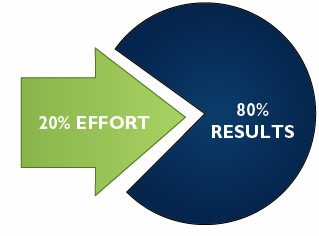
“The idea is that in many systems there is inequality between causes and effects. Real-world examples include that 80% of all complaints will come from 20% of customers, and that 80% of sales will be made by 20% of staff. In the martial arts world, the theory is that 20% of all techniques account for 80% of success, therefore 80% of training should be built around those 20% of techniques.”

David explores the challenge of applying the Pareto Principle to training by discussing the difficulty of defining “basic” techniques and by citing the success of high level grapplers that have made complex, advanced techniques (that most grapplers probably would not have been grouped into the 20% of all techniques that are effective).  These are issues worth exploring, and Matt from Aesopian.com is leading the debate, but for our purposes, the Pareto Principle provides useful guidance.

Sunday, January 22, 2012

A Voyage to the Inside of My Knee


The above video is a bit bland, maybe even worthy of some MSTK3 action, but it does a good job of explaining how the knee works and explaining the function of the meniscus, the cartilage that I tore.  In my case, I had what is called a "bucket handle tear," which is where the inner portion of the meniscus tears and then folds over itself, locking the joint in place.  When my orthopedic surgeon cut me open, he found that I had two additional tears on the outer rim of my meniscus that were also problematic.  I likely damaged the meniscus through training and the continued wear and tear culminated in what I will forever remember as Laptop Day, the day a laptop forced me to tap out.

Here are some pictures that my doctor took during the surgery: